Welcome to
Fingask Castle
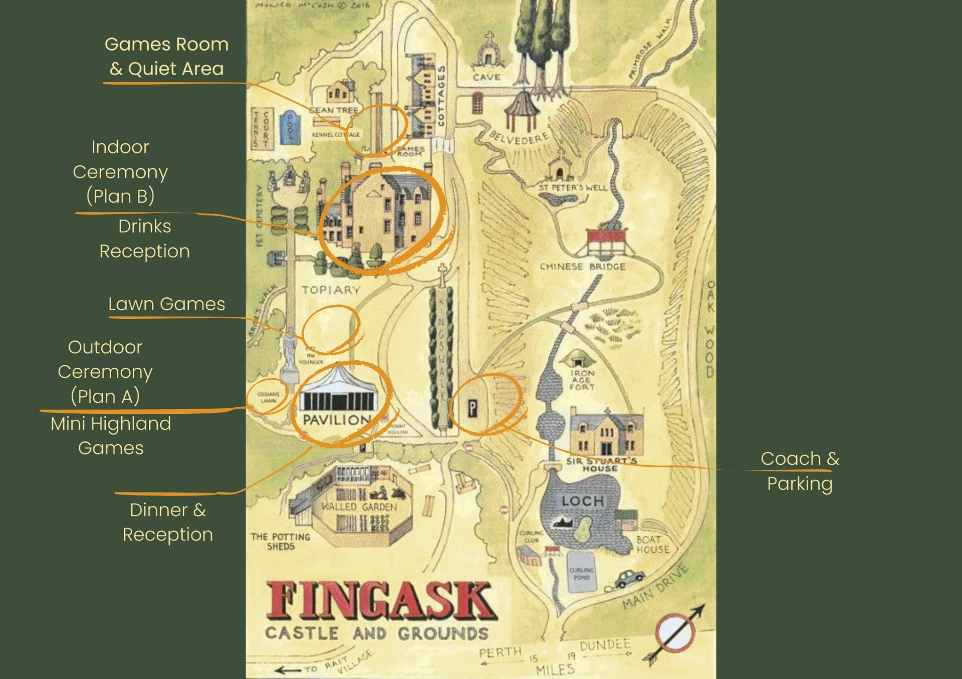
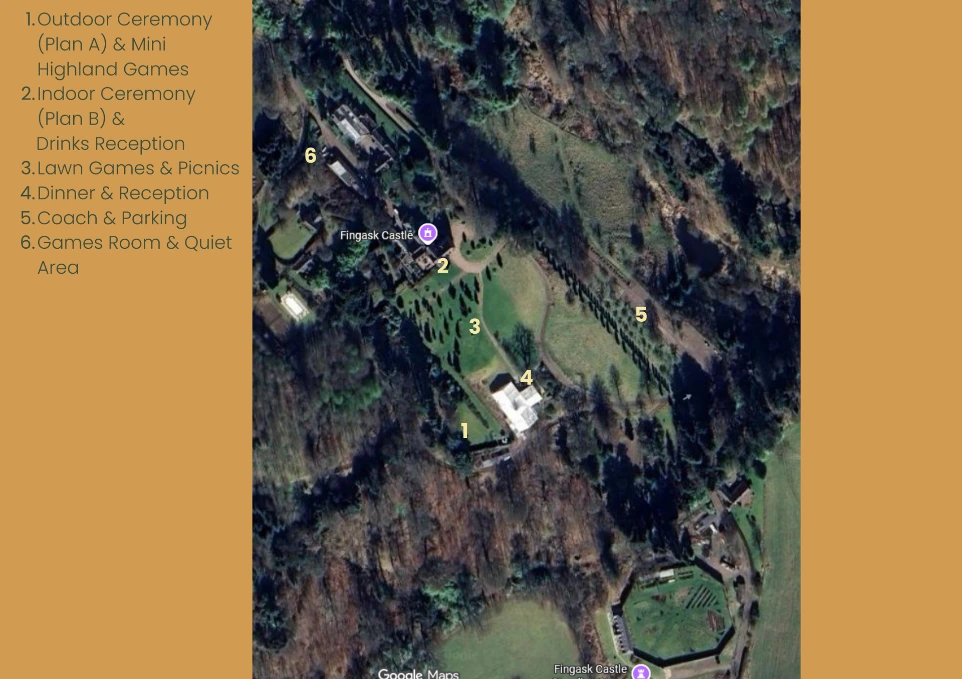
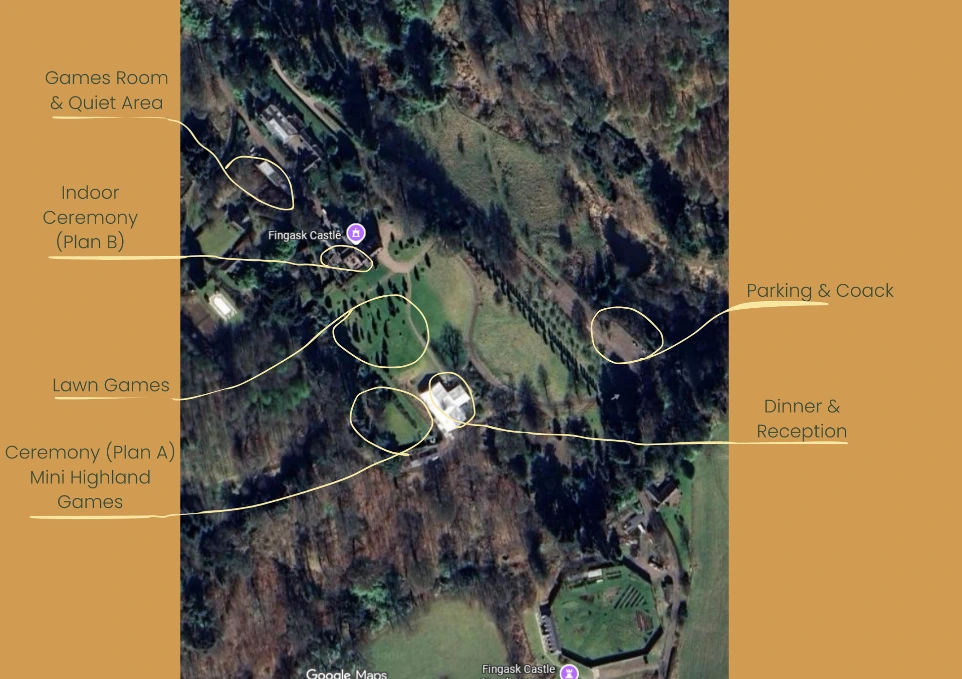
Since it’s quite a big area, we’ve included the site map, annotated with all the wedding events at the bottom of this page. Since it’s an illustrated map, it doesn’t always line up very well with trying to find things when you’re there. For those that want a bit more of a view of things, we’ve also included an annotated satellite map of the site below that. We've also added a lot of views and route maps in to the Venue Walkthrough page for those that prefer to get a clear idea of where they're going. And now a bit more about the castle and estate...
The estate references 1194 as the date of establishment, though this is likely to have been an earlier structure, with the actual castle being built in 1592.
Spiritual History
The Foundation Charter of the Abbey of Scone by Alexander I references the lands of Fingask Castle as early as 1114 or 1115, when it was used as a spiritual stopping point between the Abbey of Scone and the Falkirk Abbey. St Peters Well, in the dell below the Castle was also a place of pilgrimage for pilgrims walking from Port Allan on the tay to the shrine of St Queen Margaret in Dunkeld.
The Bruce Family
While the Dunbars likely held the land in the 14th century, the Bruce family of Clackmannan had also lived at Fingask since at least these times, and held these lands in the 15th century (as of 1399 or earlier). Patrick Bruce built the oldest parts of the castle in 1592-1594. This family is the family of King Robert the Bruce, who was King of Scots from 1306 until his death in 1329 and is the subject of the famous movie Braveheart. In 1642, it was besieged and ransacked during the Civil War.
The Jacobites and the Threiplands
The Threiplands first came to Fingask at the end of the 16th century. The family at Fingask note this as being due to a marriage between Patrick Thriepland and a member of the Bruce family, though Historic Environment Scotland and other sources reference this as being bought. He renovated the castle, considerably altering and adding to it in 1673-1674. This included adding a wing, establishing the terraces, and planting the woodlands. He also added the Braes of the Carse tower house and estate of Kinnaird to his lands. Patrick was knighted in 1674 for his suppression of Covenanters, became Provost of Perth and was created a Nova Scotia baronet in 1687. He died a prisoner at Stirling Castle for adherence to King James VII in 1689 (only two years later).
Patrick's son David was one of the first to join the Jacobite Rising in 1715, fighting with the Earl of Mar at the Battle of Sherifmuir. Following this, the castle became a Jacobite Stronghold, with James VII ("the Old Pretender") staying at the castle twice that year. Fingask was forfeited when the rising failed in 1717. David's wife leased the estates from the York Building Company (and English company which was specialising in forfeited lands), who held the land until 1783, to look after the estate for her family. In 1745, the castle was partially destroyed by Government Dragoons as penalty for the Threiplands once more supporting the Jacobites in the second Uprising, during which time Bonnie Prince Charlie visited the house. Their daughter, Dame Kathrerine (Kattrin) Threipland (known as "the lass of Gowrie") took over (rented) management of the estate following David's death at the Battle of Prestonpans.
David's younger brother, practiced as a physician, treating Prince Charles Edward (Bonnie Prince Charlie) and escaped to France after helping him. He returned to Edinburgh in 1747 and was able to buy back Fingask in 1783. While he practiced mostly in Edinburgh, it's thought that his sister Euphame Threipland ("Aunt Effie", the namesake of one of the rooms in the bridal suite of the castle) managed the estate.
In 1826, with the Act of the Parliament, Sir Patrick Thriepland, a noted scholar, was restored as Baronet, and served as Deputy Lieutenant for Perthshire and Caithness. Between 1828 and 1831, he added to the castle, continuing until 1840. He also laid out the park and planted along the ravine. (based on the history above, I'd be tempted to say he was the 3rd Baronet, but given his son was the 5th, he might have been the 4th.... I couldn't see a clear answer to this one! There might indeed have been ANOTHER Sir Patrick Threipland in between the two)
Sir Patrick Thriepland's son, Patrick, the 5th Baronet (they might also both have been known as Peter, just to further confuse things) succeeded his father. He served as a major in the Perth militia, Commissioner for Supply for the Counties of Perth and Caithness, Justice of the Peace, and Deputy Lieutenant of Perth and Caithness. He lived at Fingask with his three elder sisters and his mother, with a household staff of 7 (a housekeeper, ladies maid, cook, house maid, butler, footman and coachman). He created the topiary gardens and introduced the "statuary".
Following Sir Patrick's death, the Threipland Baronetcy becam dormant. The castle was left to his first cousin's second son, William Scott Kerr, who subsequently changed his name to William Murray Thriepland. In 1917, the castle was sold to a whisky murchant, Sir John Henderson Stewart. He made money renting out Fingask and the smaller estates of Kinnaird and Inchmichael. However, he became heavily indebted due to the Prohibition of alcohol in the USA. Following his death, the estate was purchased by H. B. Ballumey in 1925, who wholly remodelled the castle in their restorations. all spiral staircases were removed and many 18th century additions were demolished.
The Threipland family bought back the castle, with its much reduced estate in 1968 after another renovation in 1967, meaning that the Threipland family has acquired the estate 5 times and has bought the estate at least 4 of those times in the last 430 years or so! Other notable guests included Sir Walter Scott, famed Scottish poet. Externally, Fingask is listed as one of the oldest gardens in scotland. There is a walled garden and sundial dating from the 17th century and the topiary collection is the largest in Scotland. The old Perth mercat cross was also moved to the grounds of Fingask castle.
Location
Fingask Castle sits about 1.5km (1 mile) north of the A85, 61m (200ft) above Rait and the Carse of Gowrie, 5km (3 miles) North-East of Errol, 13km (8 miles) North-East of Perth, and 16km (10 miles) West of Dundee. It sits in the Braes of the Carse, on the fringes of the Sidlaw Hills overlooking the Firth of Tay and into the Kindgom of Fife. It lies on the west side of the ravine formed by the Craig Burn.
Landscape and Setting
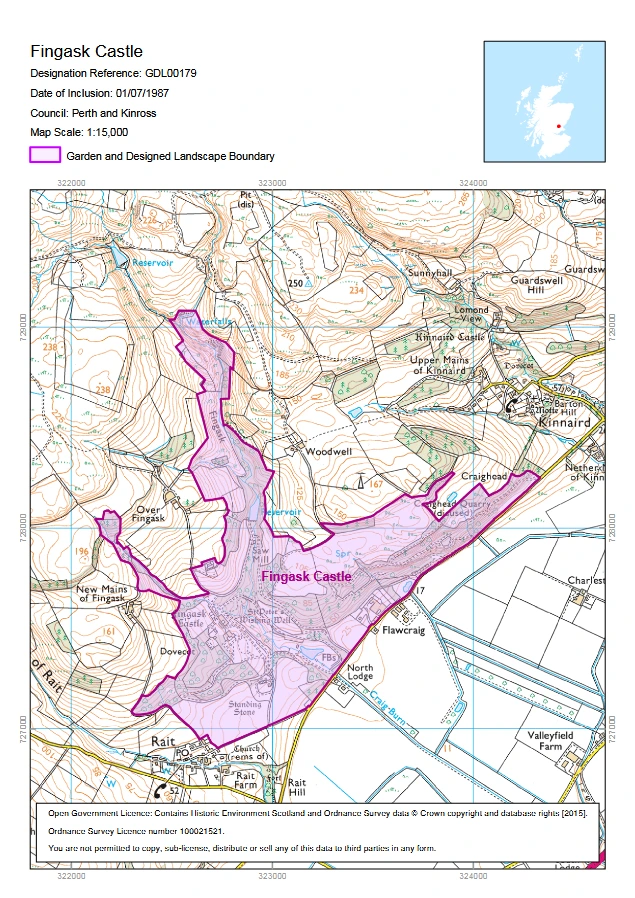
The surrounding land is primarily arable, with large stretches of woodland. The designed landscape is referenced in General Roy's plan, dated 1750 and the 1st edition Ordinance Survey plan, dated 1861. This landscape extends to the Mill Dam to the North, to Craighead to the East, to the road to Rait to the South and to Eliza's Temple to the West. There are great views from the lawns all the way over the Carse of Gowrie to the Tay, and further into the Kindom of Fife. You can see areas of three local areas (Perth & Kinross, Dundee and Fife) from the lawns.
The woodland is considered an element contributing to its horticultural, scenic and nature conservation interest. The first recorded planted woodland in the area is shon in the 1750 plan, with planting likely to have been done between 1672 and 1689. The Southern secton of the grounds extending to Eliza's temple have natural, undisturbed pastures. Broadleaf trees were planted around 1800 by Sir Peter Threipland, some of which remain today, and woodland shelter belts have been planted on steaper slopes around meadows and attractive paths. These contained oak, beech, lime and sycamore. Some of these have now been replanted with conifers such as Douglas fir and Larch. To the east near Den House, there is an old orchard. While this has been reduced from its original size, its apples do supply Diggers Cider along with Guardswell farm, so if you want to try some cider made locally, there's one for you! A curling pond and pavilion were also added in the late 19th century. There are further enormous yews dating from at least the 17th century on the edge of the bank leading to the Burn.
The Building
Fingask Castle was built in around 1592-1594 as a three storey and garret building, one of a row along the Sidlaw hills overlooking the Tay estuary, though this seems to have been build around an earlier structure established in 1194 (Fingask references this as their Establishment date). It was considerably altered and added to in 1673 and 1674 when a long wing was added. In 1745, it was badly damaged and partially demolished. In the mid 19th century, there were further additions, including a servants' wing. In 1925, the castle was renovated after dry-rot hit it, with the late Georgian entrance tower, servant's wing and other additions removed, as planning was refused.
Topiary and Statues
One of Fingask's notable features is their topiary and statues. This was created between 1850 and 1992, with ornate flowerbeds laid out amongst over 50 topiary figures of yew, box and holly. Those that still remain are in the shape of corkscrews and tall obelisks. Newer additions are tiers of circles. This is the largest topiary collection in Scotland. According to the Fingask website, the odd shapes are characteristic of the general style at Fingask, "a place which has never paid much attention to fashion, has sometimes been behind the times, sometimes in advance of them, but mostly has ignored them completely". They are described as being situated in an "erratic sort-of-line". The topiary are accompanied by a number of almost life-sized statues, dotted at random. These include Tam, his wife Kate and the three jolly beggars from Tam O'Shanter (Robert Burns), Watty and Meg (Alexander Wilson) and a statue of Lay of the Last Minstrel (Sir Walter Scott). Another stuatue represents Pitt the Younger. These statues were sculpted from single pieces of granite by Andersons (variously attributed to Peter, David or William - at least two of these, one of whom is likely to be David). The statues are assumed to have been created in the 1840s, though there is some dispute on this due to the age of the eldest sculptor at this time, and the reduced prominance of Pitt the Younger 40 years after his death. The statues were later covered in a cement wash, and were described by Gavin Stamp, a writer, TV presenter and architectural historian as the nastiest things he'd ever seen - a review the current owner of Fingask seems to relish. Andrew Threipland, current owner, moved these statues around after deciding they looked like a graveyard. There are also figures of Prince Charles and Flora MacDonald by William Anderson. There are further smaller pieces by Charles Spence, a local mason.
Other External Listed Features
There is a walled garden and sundial dating from the 17th century, which was constructed in 1562 and removed from Holyrood Palace. It's considered one of the oldest sundials in Europe, made from a complex design of a bell capital held by four rampant lions and a mermaid figure.
The old Perth mercat cross was also moved to the grounds of Fingask castle, said to be made of fragments from the 12th century and restored following its destruction by Cromwellian forces. It was moved to Fingask around 1850.
There is also an octagonal font, made in the 12th century and set on a 19th century base. There is a Well-Head standing to the west of the Castle. This consists of an ornate figure witha grotesque head and a shell basin with a lizard carved on it (probably constructed by David Anderson).
St Peter's Wishing Well (referenced above) is of medieval origin and contains an inscription offering drink to "weary pilgrims".
There is also a ruined Doocot to the west of the castle, and the North Lodge at the eastern end of the ravine. There is a monument on the north side of the ravine, and Eliza's Temple (now a ruined folly) is on the western edge. There is also an uninhabited two storey cottage (the Den House) and other cottages near the Kitchen gardens. There is a curling pavilion and curling pond. To the south of the Castle, in a courtyard, is a small rose garden and a wooden shed surrounded by topiary.
The hexagonal Kitchen Garden Walls were built at the end of the 18th century. Within this garden, Laura Kemlo (Flowers by the Brae) grows flowers - she made our bouquets, corsages and boutonnieres. On the path between the castle and the Kitchen Garden, a long line of clipped yews line a ceremonial route (occasionally referred to as the King's Walk).
Rumours & Legends
There are stories of a tunnel linking to nearby Kinnaird, which was at one time also owned by the Threiplands.
Historic Environment Scotland
Fingask is listed as one of the oldest gardens in scotland. It is listed by Historic Environment Scotland as High Artistic Interest (for the topiary garden and landscape), High Historical Interest (for the 17th century terraces and the associations with the Threipland family), Outstanding Architectural Interest (for its landscape setting of a category A listed building), Some Horticultural Interest (for the age of the older yew triees and the size of the topiary figures), Some Scenic Interest (for the woodland canopy) and Some Nature Conservation Interest (due to the undisturbed pastures and flora of the 17th century woodland). Fingask Castle itself is a Category A listed building. It also has a significant number of listed features:
The Sundial - Category A
The Statuary - Category B
The Auld Mercat Cross - Category B
The Font - Category B
The Well-Head - Category B
St Peter's Wishing Well - Category B
Kitchen Garden Walls - Category B